

.jpg)
In memory
The Royal College of Music was saddened to learn of the deaths of a number of former students, staff and supporters.
[image1]
Biddy Baxter
Biddy Baxter, legendary TV producer and a stalwart supporter of the Royal College of Music through The Biddy Baxter and John Hosier Music Trust, died on 10 August 2025.
Born on 25 May 1933, Joan Maureen ‘Biddy’ Baxter MBE became a pioneering English television producer who transformed the children’s programme Blue Peter into the cultural institution it is today. She joined the BBC in 1955, working across radio and children’s programming before taking charge of Blue Peter in the early 1960s. Her leadership introduced many features that still define the show today – the Blue Peter badge, national appeals, creative makes, much-loved pets, and a deep engagement with young viewers.
She was a loyal supporter of the College through The Biddy Baxter and John Hosier Music Trust, founded in 2003 in memory of her late husband, John Hosier (1928–2000). Hosier was a distinguished music educator, as well as producer of the schools’ television series Music Time and director of the Early Music Centre in London. The Trust provides scholarships for talented music students, enabling them to pursue post-diploma and postgraduate study. Together, Biddy Baxter and John Hosier leave behind a legacy in children’s television and music education, one rooted in a profound belief in the potential of young people.
[image2]
Daphne Boden
Daphne Boden, distinguished harpist and a cherished member of the RCM community, died in June. She taught in the RCM Junior Department and was a professor in the senior College for over 50 years. Esteemed former staff and alumni pay tribute.
Marisa Robles, former RCM harp professor, pays tribute to her great friend: ‘It would take me a very long time to say all the things I would like to say about Daphne, so I will try to cover the most important ones. Daphne was my first pupil in England. I was living in Fleetwood, and she would come all the way there to have lessons with me. This continued for several months until I moved to London.
When I first started teaching Daphne, I changed her technique from the traditional way of teaching in England, introducing her to the French school of harp. She picked this up very quickly and easily and this is the technique she adopted and passed on to her students, all her life. She would often come to my house, with students, for masterclasses and I was lucky enough to meet many of the best harp students through Daphne.
She was a very important member of the jury in international harp competitions and was highly respected and admired by her colleagues all over the world. Some of today’s best harpists began as pupils of Daphne’s at the Royal College of Music.
Daphne loved nature and she would travel to Africa every year to see animals in the wild, in many countries across the continent. She was also always completely devoted to her dogs, a love we both shared.
Daphne was very kind and was always there for me throughout the difficult times of my life, as well as the good ones. It has been heart-warming to read all the wonderful messages and tributes that so many people have written about dear Daphne. I am still coming to terms with the reality of her departure. I think about her every day with much love and I miss her, as I was lucky enough to call her my best friend.’
Alumna Helen Leitner adds: ‘Daphne loved music, the harp, and her students; she always spoke proudly of their achievements as theirs, not hers. She taught me disciplined service: to the text, to technique in order to transmit the text, to preparing that text for an audience. By that service, she made my love of music stronger than ever, more focused, more humble. They say that nobody forgets a good teacher. Daphne Boden was not just a good teacher: she was a great one, one of the greatest the harp has ever known. It was my privilege to learn from her.’
Sally Pryce, alumna and Principal Harp with Aurora Orchestra, concludes: ‘Without the guidance Daphne gave me throughout all those years of study, I would not be the harpist I am today. From the fundamental technical foundations through to international competitions, she was an incredible teacher. Daphne always had high expectations of her students and was immensely proud of their achievements. In more recent years when I spoke to her, she always loved to hear about what I was up to and tell me about her current group of students and spoke of all their successes with such joy. A true legend of the harp world has left us.’
[image4]
Brian Beresford
Brian Beresford, who studied voice and piano at the Royal College of Music in the 1960s, died on 13 November 2024 following a long illness.
At school, Brian became interested in musical theatre through his father, who built and painted sets. When Brian left school, he joined a musical society and performed in various productions, where his musical abilities were noticed by a family who ran a local private school. They employed him and nurtured his musical gifts.
Brian worked hard and was awarded a place at the Royal College of Music, where he studied between 1960 and 1963: singing with Jan van der Gucht and Hervey Alan, and piano with David Parkhouse. He was also active as a composer.
After graduating, Brian was offered work that could have led to a career as a full-time musician, but opted instead to spend the next several years teaching and encouraging others to blossom, alongside engagements as a soloist and in amateur theatre.
Brian and his wife applied for short-term teaching positions overseas, arriving in New Zealand in 1970 intending to stay for just three years – which became 54. Brian enjoyed many opportunities to sing and act professionally there, and in 1974 was offered the role of the Mikado, going on to perform in many theatrical and television productions. He helped create opportunities for other performers by presenting regular Music Halls.
Brian later returned to teaching, and encouraged many more students to flourish. His school productions of Gilbert and Sullivan will long be remembered by all involved.
Brian was a man of many talents; the Royal College of Music cultivated these, and changed his life. Sadly, those talents were lost in his later years as Parkinson’s took hold, but Brian will be remembered for his generous teachings, booming baritone, acting talent, and his skill at playing any piano that crossed his path.
Rosemary Beresford (widow), Katherine Beresford (daughter), Barry Dorking (friend)
[image3]
Sir Anthony Cleaver
The Royal College of Music is deeply saddened to learn of the death of Sir Anthony Cleaver FRCM (1938–2025), former Chairman of Council (1999–2007) and Vice President (2007–2025).
Sir Anthony was in many ways the very embodiment of the Albertopolis vision, with an equal passion for science and technology and for the arts. As Chairman of Council, he was a quiet yet confident figure, whose authoritative influence was extremely beneficial to the RCM during a time of considerable change.
Music was at the heart of his life from an early age, and Sir Anthony would later remark, ‘I owe my very existence to music – my father played the violin and my mother was a pianist. They were introduced to each other, aged ten and 12, to play duets.’ His subsequent academic trajectory reflected his towering intellectual brilliance. After National Service, during which he worked in intelligence as a Russian linguist and Arabic listener, he read Greats at Trinity College, Oxford. In 1962 he joined IBM, where he spent 31 years. Rising to Chief Executive and Chairman of IBM UK, he oversaw its growth from a modest operation into a multibillion-pound enterprise.
Sir Anthony retained a lifelong love of Greek and Latin; he was a major supporter of Classics for All, whose mission was to promote these subjects in state schools. A devotee of opera and passionate advocate for the performing arts, he also served as Deputy Chair of English National Opera and on the Council of the Association for Business Sponsorship of the Arts. In later life he became what he himself called a ‘serial chairman’ and applied his expertise across a huge range of interests. He championed STEM education as Chair of EngineeringUK, and served as Chairman of Birkbeck College, the UK Atomic Energy Authority, the UK Nuclear Decommissioning Authority and the Medical Research Council. In recognition of his contributions to industry and public life, he was knighted in 1992.
Sir Anthony Cleaver will be fondly remembered at the RCM as a dear friend and generous supporter; he was a truly impressive Renaissance man, whom it was a privilege to have known.
Professor Colin Lawson, CBE
Adrian Fisher
Tenor Adrian Fisher, an alumnus of the Royal College of Music Opera School, died in May.
Adrian was born in Leeds to János Fischer and Marieanne Frank, Jewish refugees who escaped Germany and arrived in the UK in 1939. Adrian attended Bradford Grammar School before studying drama at the University of Kent and at the Webber Douglas Academy of Dramatic Art in London. An acting career followed before Adrian decided to retrain in opera, studying with Kenneth Woollam at the Royal College of Music between 1987 and 1988.
Adrian’s operatic career took him across the UK and Ireland, including performances at Glyndebourne and, in 1988, his West End debut at the Donmar theatre. He was based in Antwerp in Belgium for much of his life, and performed in over 700 productions at Vlaamse Opera House between 1992 and 2004, after which he toured Europe in solo roles. He performed at major opera houses throughout Europe, including Antwerp, Cologne, Düsseldorf, Luxembourg and the Concertgebouw in Amsterdam, as well as summer opera festivals. He also wrote and starred in The Two Most Perfect Things at the Jermyn Street Theatre in London.
Adrian is survived by his sister, Rosalind, and his nieces, Katie and Nikki.
Diana McVeagh
Esteemed author on classical music Diana McVeagh, who studied at the Royal College of Music in the 1940s, died on 2 July 2025 at the age of 98.
Diana was born on 6 September 1926 to John, a rubber plantation manager, and Margaret, who had studied singing with Harry Plunket Greene at the Royal College of Music. After schooling at Malvern Girls’ College, Diana followed in her mother’s footsteps, studying at the RCM in the 1940s. Diana had hoped to study the piano with Kathleen Long, but a broken hand prevented this so instead she took lessons with Frank Howes, music critic of The Times, for whom Diana wrote numerous reviews. She was awarded an ARCM in Piano Teaching in April 1947, and a GRSM in September 1947. She married pathologist Bill Morley in 1940.
Diana was a noted authority on composers such as Elgar and Finzi, writing several books on Elgar and a biography of Finzi, as well as editing a volume of Finzi’s letters. Her first book on Elgar, Edward Elgar: His Life and Music (1955) was commissioned when she was still in her 20s and predated other major works on the composer. On the strength of her writing on Elgar, Finzi’s family approached Diana to write his biography, saying that they were ‘charmed by her bright personality.’
She also worked as an assistant editor at The Musical Times and on the editorial board of the New Grove Dictionary of Music and Musicians. Since 2013, the North American British Music Studies Association awards a biennial Diana McVeagh Prize for Best Book on British Music.
Sir Roger Norrington
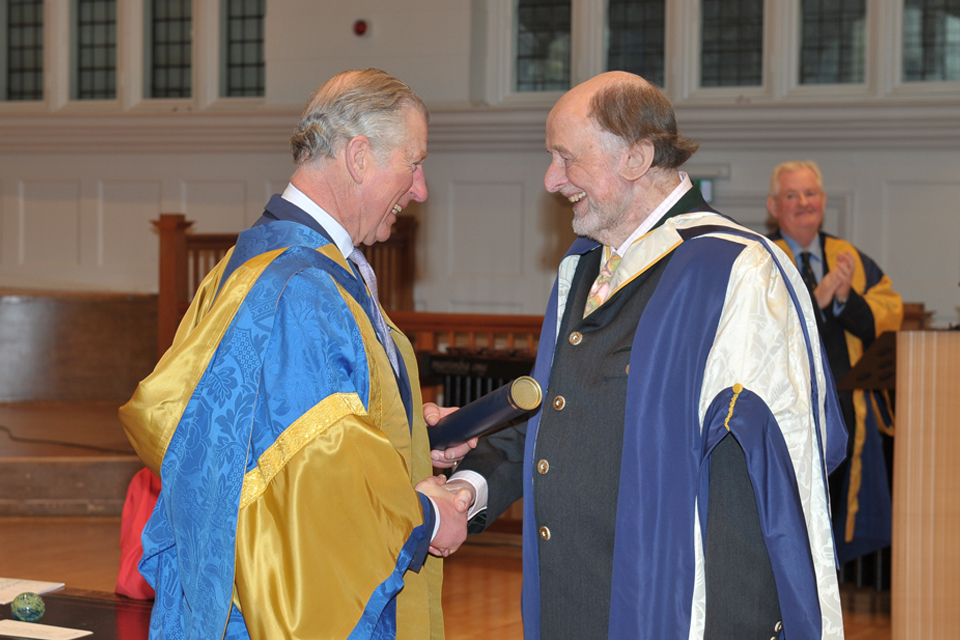
The Royal College of Music was saddened to learn of the passing on 18 July 2025 of Sir Roger Norrington (main picture), RCM alumnus and Prince Consort Professor of Historical Performance.
An inspirational conductor, Roger worked closely with RCM students on many occasions, notably directing the Baroque Orchestra at the BBC Proms in 2012 and leading a radical performance of Berlioz’ Symphonie Fantastique in 2014 with the RCM Symphony Orchestra. He received an Honorary Doctorate from His Majesty King Charles III (then Prince of Wales) in 2016.
I had the great pleasure of interviewing him as part of the Director’s Choice online series during the dark days of Covid in 2020. On that occasion, he enthused about Berlioz and the high musical standards of RCM students, as well as many of his signature (and controversial) concerns, including the importance of composers’ metronome markings, the value of historical orchestral placements and the desirability of avoiding string vibrato in orchestral music before 1930.
Roger was a warm, collegial man, quite lacking in malice – and a delightful companion. His love of music was inspirational. I had the good fortune to play principal clarinet in his London Classical Players for a few years from the late 1980s. It was remarkable to witness at first hand the positive response in Germany to his radical reimagining of Beethoven symphonies and to experience his light-footed approach to late Mozart. In the 1990s, he faced the challenge of an incurable blood cancer. Ever determined, he explored treatment options in the USA and went on to enjoy many more years of life.
Roger studied history and literature at Cambridge and then worked for Oxford University Press, publishing religious books. In the early 1960s, he founded the Schütz Choir of London, which was heard by RCM Director Sir Keith Falkner, who persuaded him to study conducting with Sir Adrian Boult. He was Musical Director of Kent Opera from 1969 to 1984, founding the London Classical Players in 1978. In the late 1980s and early 1990s he was successively Principal Conductor of the Bournemouth Sinfonietta and the Orchestra of St Luke’s in New York.
In Europe, he was Principal Conductor of Camerata Salzburg from 1997 to 2007 and of the Stuttgart Radio Symphony Orchestra from 1998 to 2011. Especially with the latter ensemble, he translated his experiences with period instruments to the modern orchestra. He held other posts in Boston, Paris, Bremen and Zurich, making regular appearances with the Vienna and Berlin Philharmonics. We mourn his loss but are proud to count him among our most distinguished alumni.
Professor Colin Lawson, CBE
Andrew Pledge
Andrew Frederick Pledge, an alumnus of the Royal College of Music who went on to become Professor of Music at Brunel University, died on 5 September at the age of 87.
Andrew began his studies at the Royal College of Music in 1957. His principal study was piano, with Angus Morrison and Cyril Smith. His second study, organ, was pursued under the guidance of Richard Latham, and he also studied the cello with Helen Just. Andrew performed regularly as an accompanist, as part of a duo, and as a soloist, notably in a College performance of Weber’s Konzertstück on 6 February 1962.
Andrew went on to have a distinguished career in music education, spending several years as an examiner in both the UK and overseas. In later life, he was a Professor of Music at Brunel University, and was well loved as a teacher. He continued to teach until his last days.
Violinist Fenella Humphreys added: ‘I’ve been lucky to have some incredible music teachers, from violin and chamber music teachers back to my first primary school music lessons. I wouldn’t be who I am without all of them. But the one person who stayed constant through everything was my piano teacher Andrew Pledge. I wasn’t a great pianist and never practised enough, but he put up with me and always encouraged. He had a gentle, no-nonsense approach both to teaching and to making music. He wasn’t into big, flowery performing, but condensed musical ideas that packed a punch and really said something. He also believed that musicians need to be well-rounded people. He used to accompany me for violin performances, and was great at helping me understand the bigger picture in the music rather than just focusing on the violin part. I’ve recently been revisiting some of the repertoire we played together when I was a teenager, and it’s made me realise just how much he helped me, as well as what an brilliant musician and pianist he was.’
Michael Pledge, Andrew’s nephew
[image6]
Doreen Price
Soprano Doreen Price, former Leverhulme Scholar at the Royal College of Music, died unexpectedly but peacefully on 14 November 2024 at the age 87.
Doreen Price (later Doreen Whiston) was born in a snowstorm on 15 February 1937. The first inklings of her future as a performer emerged in her family’s Anderson Shelter, where she used a hollyhock as a microphone while she serenaded everyone.
From 1947, her singing talents were further developed at Wirral Grammar School for Girls. Doreen competed at music festivals around Cheshire, culminating in a win at the Blackpool Festival, and a then-record five wins at Llangollen International Eisteddfod. 1956 saw Doreen enter the Kathleen Ferrier Competition, advancing to the final; she was one of only two competitors not in attendance at music college. She faced fierce competition that day, performing alongside Maureen Lehane and Dame Janet Baker.
Seeing Doreen’s success, and being advised of her potential as a professional soprano, her employers Lever Brothers awarded her a Leverhulme Scholarship to attend the Royal College of Music, and she commenced study in September 1960. She earned extra money in between her studies by performing in choirs in London churches, including at the Guards Chapel and society weddings. She met David Whiston, a violinist in his second year at the RCM, and they married soon afterwards.
Doreen commenced studying at a transformational time for music. Her performance as first soprano in Messiaen’s Cinq Rechants demonstrated her capabilities, opening the doors to her future career. Giving birth to Vivienne in 1962 did nothing to stop Doreen’s hectic schedule, and Vivienne would attend Doreen’s lessons and rehearsals asleep in her carry cot, including one of Doreen’s first post-College roles, The Happy Prince.
Doreen performed a range of chorus and small opera roles when soloists such as Luciano Pavarotti, Leontyne Price and Joan Sutherland toured the UK, and she expanded into the newly emerging vocal repertoire used in ballet, working with Berio for Laborintus II in 1965, and singing alongside Nureyev at the Royal Opera House in 1972. Doreen also appeared on soundtracks such as One Million Years B.C., Scrooge (1970) and 200 Motels. Unsuccessful nodule surgery necessitated a career change and she became a case-worker for the Department of Social Services.
Aside from her love for the pastoral works of RCM alumnus Vaughan Williams, Doreen enjoyed a varied taste in music, becoming particularly enamoured with both Rammstein and System of a Down, as introduced to her by her grandson, Roch. Doreen’s other loves included genealogy, GrandMaster SuDoku, good whiskey, and sticky toffee pudding; fortunately, she was able to spend many years enjoying these with her loved ones.
Roch McLean, Doreen’s grandson
David Rendall
The Royal College of Music is deeply saddened by the death of tenor David Rendall, a much-loved Vocal & Opera professor at the RCM for many years.
David was in great demand at home and internationally, achieving widespread acclaim throughout his career. He was a frequent performer at the world’s leading opera houses: the Royal Opera House, Covent Garden, Metropolitan Opera, New York, La Scala, Milan, Glyndebourne, Deutsche Oper, Berlin and English National Opera, among others. He worked with some of the world’s greatest conductors including Karajan, Bernstein, Barenboim, MacKerras and Davis.
He died peacefully at home in the New Forest with his family by his side. He is survived by his wife, the beloved mezzo soprano Diana Montague, and their three children, Eleanor, Amelia and Huw, and by his two children, Edward and Elizabeth from his first marriage.
David’s son, Huw Montague Rendall, a wonderful baritone and alumnus of the RCM said: ‘He poured every part of his personality, his soul, his expression into every role.’ David is a great loss as an artist and teacher.
Audrey Hyland, Head of Vocal & Opera
[image5]
Francis Shaw
Francis Shaw, a highly esteemed Composition for Screen professor at the Royal College of Music, died on 22 August 2025.
Francis Shaw (b 1942) was a much-loved and admired member of the Composition Faculty at the Royal College of Music. Prior to joining the RCM, his many teaching posts included being Head of Screen Composition at the National Film and Television School, and professor at the Guildhall School of Music & Drama. Whilst at the RCM, he was instrumental in setting up the Composition for Screen Programme.
In film and television, his work included scores for A Room With A View, Fourth Protocol and Ondskan, for which he was awarded the Ivor Novello Award for Best Film Score, whilst his extensive catalogue of concert works included concertos for piano, viola and harpsichord, and two operas.
A popular teacher with students and staff alike, and always generous with his time and expertise, Francis personified the increasingly rare ideal of a composer as craftsman, bringing great skill and understanding to all his projects and a real passion and dedication to his teaching. Hugely admired within the music industry, he was a Composer Director of the PRS from 2004–2007 and a founding member of BASCA.
Area Leader in Composition for Screen, Dr Dimitri Scarlato writes: ‘Francis was always a dedicated and passionate teacher, with an extensive compositional knowledge that went beyond film and TV scoring. He was a composer, a conductor and an arranger who wanted to share and transmit his expertise to students and colleagues. I feel lucky that I have the opportunity of working with him during his last teaching years.’ Former Head of Composition, Professor William Mival, added that ‘Francis was at the heart of music-making in all its forms. He would be at every faculty meeting and joined every discussion, passionately fighting his corner, not just for his own students but for composers across the College as a whole. He was a joy to know, loyal, always engaging and an utterly committed colleague, and someone I shall miss very much.’
Professor Jonathan Cole, Chair and Head of Composition