

All the World’s a Stage: 25 years of RCM Performance Science
Share #RCMUpbeat
Butterflies, sweaty palms, memory faltering... We’ve all experienced those nervous feelings during a presentation or performance, when you’re suddenly confronted with your audience. However much you’ve practised, the real thing feels so different. So how can we prepare? As the Royal College of Music celebrates 25 years of Performance Science, Upbeat delves into the award-winning research empowering performers in a range of professions.
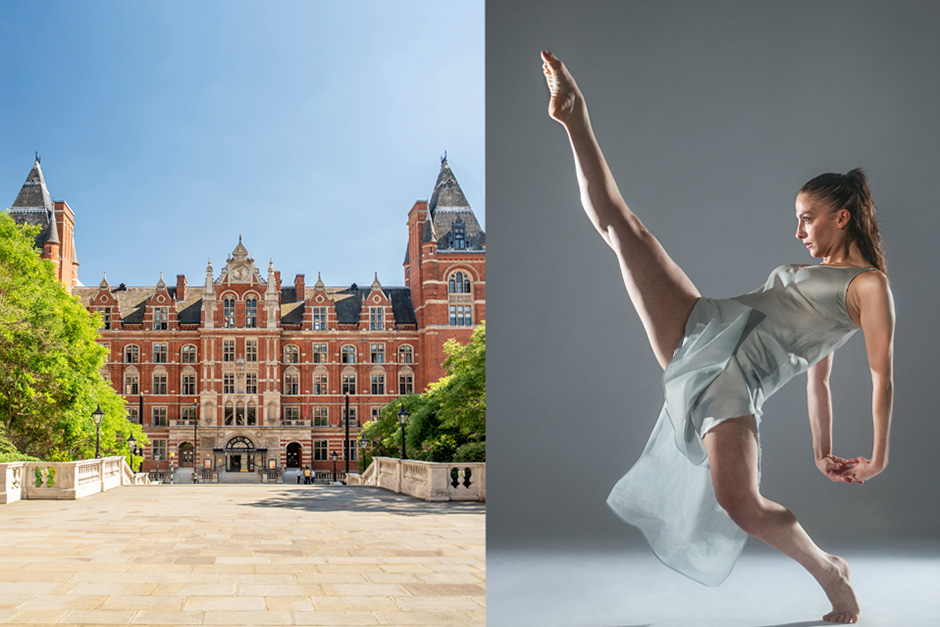
At the heart of the celebrations is the Centre for Performance Science (CPS), formed in 2000 and recently awarded the highest national honour in UK higher and further education, the Queen Elizabeth Prize for Education.
In 2015, the RCM joined forces with Imperial College London to establish a cross-institutional partnership in performance science, embracing an interdisciplinary approach via lively exchanges of ideas. Those ideas are shared in a range of contexts, from prestigious international conferences to podcasts.
[image1]
Performance arcs: adrenaline to aftermath
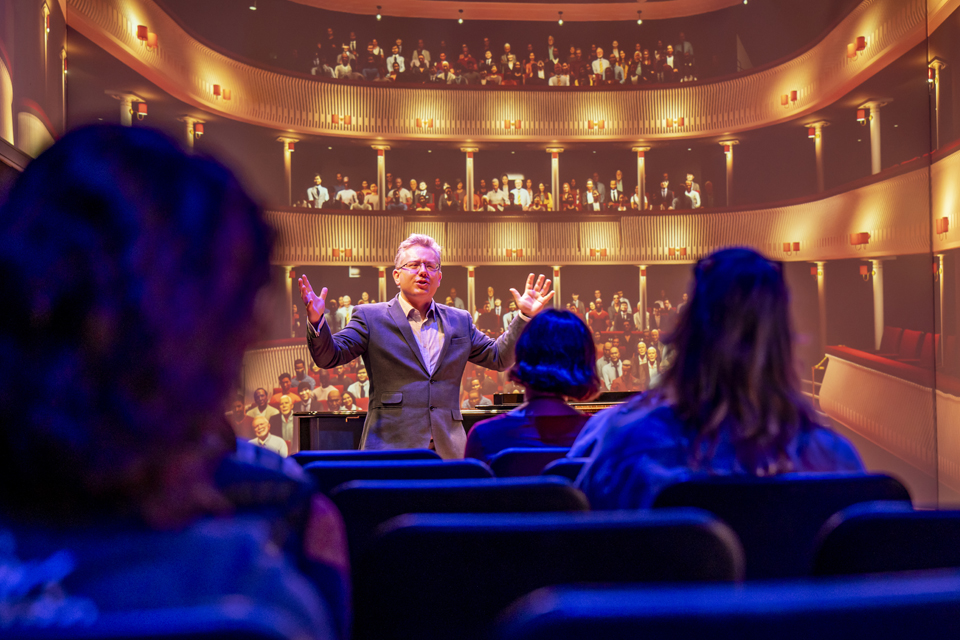
The lights are dimmed in the RCM Performance Studio, and all eyes are drawn to the very real-looking audience rising to its feet in front of us, delivering an enthusiastic standing ovation. ‘I stand in front of this every day,’ jokes Professor Aaron Williamon, Head of the CPS, putting the real audience at ease – one of many times during a presentation that’s a model of assured public speaking.
Aaron is showing us the RCM Performance Simulator as part of an event celebrating 25 years of RCM Performance Science, reminding us in the process that public speaking is a type of performance necessary to many careers. We’re used to thinking of performance in musical and theatrical terms, but it’s part of widely divergent career paths, many of which can learn from one another. The arc of performance – adrenaline, risk, aftermath – is common to countless walks of life.
[quote quote="Supporting our artists means that we’re also helping the health of society more generally." author="Professor Aaron Williamon"]
Prepare to be the best – by experiencing the worst!
So how can we tackle nerves, stage fright, muscle tension, distractions, without having to plunge straight in and hope for the best?
During his presentation, Aaron offers one solution, by showing us what the Performance Simulator – a world-first – can do. This extraordinary innovation enables students and other performers to leave behind the confines of a practice room and experience how it feels to play or sing in front of an audience or audition panel.
Every one of those simulated listeners has been modelled on real audience behaviours and performance environments, from coughs and phone interruptions to different audience sizes and levels of enthusiasm. There are even different acoustics, so that musicians can get used to playing anywhere from a dry and unforgiving space to a resonant cathedral.
[image2]
Pilots to puppeteers, medicine to music
The CPS is made up of a diverse band of experts. Where else might you find a surgeon and a puppeteer comparing notes? And what could they possibly learn from one another? A lot, as it turns out: the resident CPS puppeteer Rachel Warr told Imperial’s Professor of Surgical Education and Engagement Science, Roger Kneebone, about her warm-up process, something familiar to artists and athletes, and then asked how surgeons warm up before surgery (spoiler, they didn’t). It was a lightbulb moment; Roger recognised just one of the ways that surgery is a performance that can be made more efficient through learning from other disciplines.
Before the CPS was formed, Roger had been inspired by pilots using cockpit simulators to create the medical equivalent. In collaboration with the Royal College of Art, Imperial built a portable surgical simulator that could be taken to different institutions and events, allowing people to use it and inviting questions from the public – which led to further insights that helped Roger and his team improve training. Through working with Roger, Aaron and the RCM’s Performance Science team conceived a musical embodiment of this idea, which has been refined over the years to create the Performance Simulator in use today.
[quote quote="The arts bring a lot to the table when it comes to bringing people together, in making people feel connected, fighting loneliness – we need to bridge that gap between thinking of the arts as a nice add-on, to a central plank of how our society functions." author="Professor Aaron Williamon"]
Enriching wellbeing
Alongside the Performance Simulator, the CPS team is at the cutting edge of Performance Science research, with Professor Rosie Perkins and Dr Neta Spiro specialising in exploring ways music supports wellbeing. Their studies have been pronounced ‘world-leading’ by the Research Excellence Framework, thanks to their ‘strong, clear narrative of outstanding impact on improved health and wellbeing.’
[image3]
[quote quote="... the majority of adults taking part – 82% – told us that their participation in the arts is linked with feelings of social connectedness ... the arts can support public health challenges like reducing loneliness or alleviating symptoms of mental illness." author="Professor Rosie Perkins"]
[video1]
The HEartS (Health, Economic and Social Impact of the ARTs) project aimed to collate robust evidence of these links between music and wellbeing. As Neta explained: ‘The study gathered large-scale numerical data looking at the connections between arts engagement and health’.
Both Rosie and Neta continue to lead the way in this research, with Rosie establishing the Music and Parental Wellbeing Research Network, and Neta collaborating on The Musical Care International Network. Read more in our Upbeat feature from spring 2024: Music and Wellbeing: New networks created by RCM Researchers.
Taking the ineffable and making it tangible
Another key figure in the Centre for Performance Science is Dr George Waddell, who joined the team at around the time the new relationship with Imperial was forged. George had trained as a classical pianist and in psychology, and was fascinated by the connections between the two fields. Reading Aaron’s book Musical Excellence (OUP, 2004) was a revelation: ‘I realised my people were out there’.
George champions the Performance Simulator as something available for students and staff ‘to use on their own terms’. He sees it as a way of helping musicians forge portfolio careers, in which artists are also called to be versatile entrepreneurs, by practising those parts of performance that used to be more theoretical: ‘We can take the ineffable and make it tangible’.
[quote quote="Performance Science is a celebration of what it means to be human." author="Dr George Waddell"]
Celebrating humanity
So what might the future hold? Roger argues that the CPS has ‘laid the groundwork’, creating opportunities to demonstrate that performance is integral to how people do expert work, widening general understanding of these principles. He also speaks of reaching an accommodation with risk, understanding that it is part of work, and how to make peace with that as part of professional performance.
George mentions the role of AI in future discussions, saying that he is ‘equally terrified and fascinated by AI’ while emphasising that Performance Science is ‘the study of human endeavour’. He suggests that one response to AI and any subsequent scepticism around the authenticity of performance footage – which could be created or doctored artificially – may be a renewed interest in live performance. After all, the study of performance is, as George puts it, ‘the study of what it means to be human. It’s a celebration of what it means to be human.’
In a nutshell
The Centre for Performance Science community
- 2 professors, 2 readers and 2 lecturers
- 3 fixed-term early career researchers
- Over 45 PhD and MSc students
Collaborators
- 7 Imperial professors
- 13 performers-in-residence: experts from broadcasting, bespoke tailoring, combat flying, illustration, magic, puppetry and more
- Leadership of three international networks/alliances, including Healthy Conservatoires, the Music and Parental Wellbeing Research Network, and the Musical Care International Network
Awards
- Queen Elizabeth Prize for Education (2025)
- Named a Nation’s Lifesaver as part of Universities UK’s ‘Made at Uni’ campaign (2019)
- The Royal Society for Public Health’s Arts and Health Award (2016)
- Over £18.2m awarded in grants since 2000
Workshops
The CPS gives workshops/training in a range of contexts, recent examples including:
- Football Association
- Imperial College Business School
- United Nations Development Programme (UNDP).
25 Years of RCM Performance Science: Timeline
Join the celebration at one of our CPS 25 events: Performance Science 25 - Centre for Performance Science
Figures correct at time of publication.

Publications Officer Joanna Wyld is a writer and librettist who has written CD liner and programme notes for organisations such as the BBC Proms, Southbank Centre, Wigmore Hall and Salzburg Festival.