

Spontaneous Composition: Improvisation at the Royal College of Music
Share #RCMUpbeat
How can you compose in real time? And what can improvisation skills add to your other performances? The Royal College of Music is the only UK conservatoire consistently embedding improvisation into the curriculum. Upbeat caught up with the staff and students revolutionising the way we approach musical creativity.
We are in the RCM Performance Studio, and alongside experimental timbres are sounds of enjoyment – students laughing and engaging in animated conversation about the music they’re creating together. This is a contemporary improvisation session run by Dr Gerardo Gozzi, who, when not improvising on the saxophone, is guiding and encouraging the students. In collaboration with a team of expert staff, Gerardo has been working on the way improvisation is taught at the Royal College of Music, developing the curriculum over the past three years. It is now a core component of the undergraduate course for every student, a structure that is unique in the UK. The RCM is also one of only a handful of conservatoires in the world offering improvisation in this way.
[image1]
Alongside the students’ palpable joy in the process, one soon notices the aspects of musicianship being developed. There is a sense of heightened awareness – without scores, these musicians are acutely conscious of one another and of sound, noticing patterns, reacting, paying attention to sonority and structure as it unfolds. Sometimes the effect is dream-like and hypnotic, at others playful, and there is an almost magical quality of mutual understanding, with a collective, unspoken agreement as to when the piece will end.
Yet alongside this focus, there is relaxation, too – freedom to test the sonic possibilities of instruments and voices. We hear unusual and extended techniques – muted brass, bowed percussion, tapping keys, harmonics, overblowing, and an effect on the trombone that sounds uncannily like a didgeridoo.
[image2]
When ‘mistakes’ become motifs
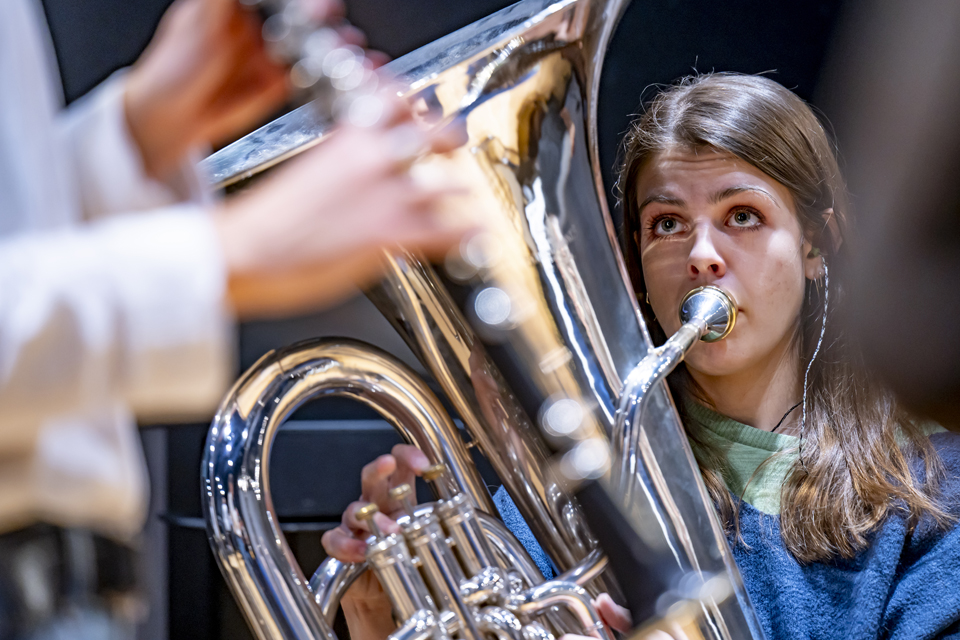
There is also exploration of space – the ensemble divides into two groups, creating dialogue, even conflict, as well as intriguing questions of hierarchy – are the on- and off-stage groupings of equal prominence, or is one accompanying the other? ‘Mistakes’ are transformed into motifs, a musical alchemy turning unpromising material into gold. When percussionist Hoi Yin Ng unintentionally hits a resonator, Sunny Anderson taps her tuba in response. This subverts what we might expect in a performance environment: competition becomes collaboration, and there is an underlying, unpatronising kindness being fostered, musicians developing each other’s ideas rather than focusing on individualistic brilliance.
[quote quote="The great advantage of improvisation is that you realise the wrong note is always one step away from the right one. Once that enters a student’s mentality, they’re much more relaxed." author="Dr Gerardo Gozzi"]
The students discuss the experience with Gerardo. One suggests that improvisation means becoming a musical ‘island’, free and independent; another extends the metaphor by saying they’re more familiar with ‘being the sand’ – the background, fitting in. It’s fascinating to hear them explore their relationship with performance in this way.
[image3]
Transferable skills: Baroque and beyond
Students at the College study improvisation within the Theory module, focusing on common practice tonal frameworks such as ground basses. This then branches into a separate study, with further room to explore. The three main areas of improvisation taught are baroque, jazz and contemporary. Both Gerardo and his colleague, cellist and fellow RCM Improvisation professor Shirley Smart – who teaches improvisation at Junior and Senior Colleges – emphasise the links between these fields.
Gerardo explains: ‘Much of jazz harmony still follows principles that were there in the baroque – and the great baroque soloists were much closer in feel to jazz improvisers; the idiosyncrasies, individualities were there. The principles of improvisation are transferable.’ These connections apply to the Classical era, too: ‘In our industry we are striving to interpret Mozart, Beethoven and so on while overlooking the fact that every single musician at that time started their musical journey improvising, singing and composing – this is how everybody was trained before they touched an instrument.’
Shirley puts this into an even broader context: ‘Improvisation is a fundamental and integral part of performance practice in every musical tradition in the world. Western classical music is the only one where it’s largely disappeared from the education system. But prepared performance and improvisation are on a continuum of music making, not in competition.’ Both Gerardo and Shirley are involved in the improvised music scene in the UK and internationally, giving them real-world understanding of how this skill connects with the wider music industry.
[image4]
Distilled improvisation: thinking like a composer
Shirley echoes Gerardo’s emphasis on the ‘transferability of skills you learn through improvisation. Between the baroque and jazz up to about the 1950s, there’s so much in common: chord constructions, functional harmony, voice-leading principles. Once you understand those, you have the tools to work with both languages. Understanding that a lot of the repertoire grew out of improvisational practices, you learn that composition is distilled improvisation; you learn about compositional thinking.’
[quote quote="Students find improvisation very helpful to connect theory and practice – harmony is no longer this abstract thing on paper in theory classes, but a practical tool they use all the time." author="RCM Improvisation professor Shirley Smart"]
Connecting theory and practice
This has a practical application: the theoretical parts of a student’s musical education become a living part of their performances rather than a separate discipline. Shirley suggests that ‘students find improvisation very helpful to connect theory and practice – harmony is no longer this abstract thing on paper in theory classes, but a practical tool they use all the time.’
As Gerardo puts it: ‘We teach students to think about how a piece of music is built, the layers in a piece – and to take responsibility for them. We teach them to listen to the vertical layers – harmonic progressions – as well as the horizontal melodic lines unfolding. What is your role within the piece? How do we create contrast? How do we make material meaningful? We encourage students to pay attention, to explore the psychology of listening.’
[image5]
Empowering performance
This brings us to contemporary or free improvisation, when functional harmony is shed but an awareness of other facets of music is increased, empowering students with a new confidence that they bring to their performances of existing repertoire. As Gerardo says: ‘Students are often scared of wrong notes – and this is an industry problem. The great advantage of improvisation is that you realise the wrong note is always one step away from the right one. Once that enters a student’s mentality, they’re much more relaxed. One of the first things we teach is to take an idea, even if it’s accidental or you don’t like it – give it dignity, work on it, give it meaning, take collective responsibility for it.’
[quote quote="One of the best decisions in my time at the RCM was to choose this module, because it gives you a new perspective; it’s really worth doing." author="Cellist Philip Heide, RCM alumnus"]
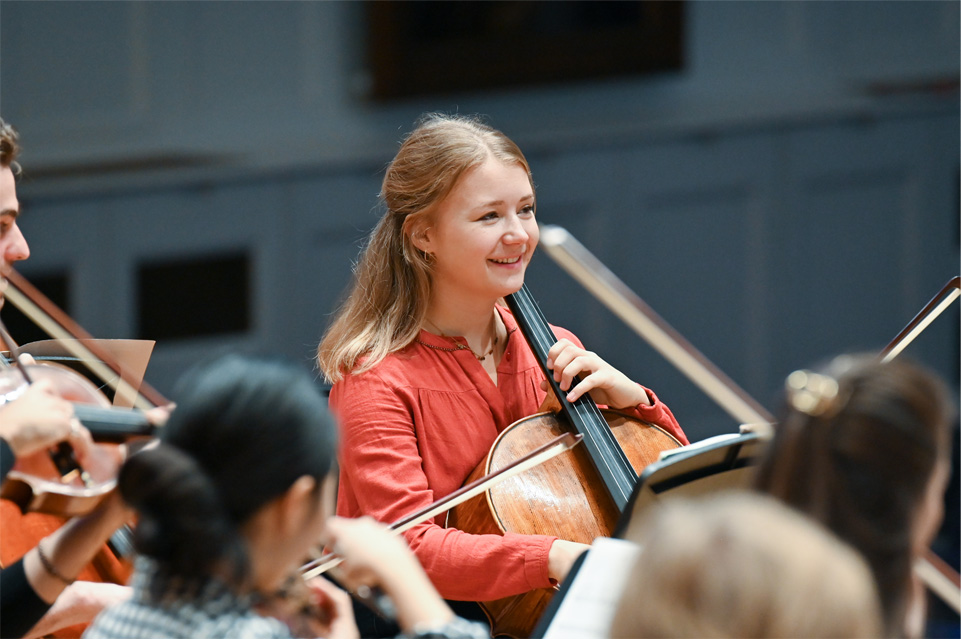
Alumnus, cellist Philip Heide, was so inspired by improvisation at the RCM that he joined the London Improvising Orchestra – of which Gerardo is also a member – and intends to continue with improvisation in the next stages of his career: ‘I felt much freer on stage. Improvising was part of classical performance 200 years ago and somehow this isn’t the case now. It’s good to go onstage as a classical musician with an improviser’s mindset: it’s about not taking things too seriously and finding the joy. One of the best decisions in my time at the RCM was to choose this module, because it gives you a new perspective; it’s really worth doing.’
[image6]
Rewiring your mindset
So how does it feel to improvise when you’re used to written notation? Philip describes the sensation: ‘It’s strange at the beginning; it takes time to feel really confident and to be free.’ Gerardo adds: ‘There’s this perception that improvisation is an innate talent you’re either born with or not. But those of us teaching improvisation at the RCM had to build our skills, so we’re living testimony that you need to take time over it, regularly, to understand and maintain this skill.’
Improvisation forges a new, enriching way of engaging with performance: ‘When you’re improvising you need to re-route your brain to listen, invent, reflect how you respond while still playing. It’s a new way of thinking that goes beyond our technical abilities. In the long run, students learn independence from muscle memory and visual input, keeping things moving while another part of the brain is listening and thinking ahead. The benefits are immeasurable. And it’s a lot of fun.’
See Dr Gerardo Gozzi discussing RCM Improvisation during our Music & Ideas talk on 11 February 2026: Music and Ideas: Mozart Improvised, Why Don't We?

Publications Officer Joanna Wyld is a writer and librettist who has written CD liner and programme notes for organisations such as the BBC Proms, Southbank Centre, Wigmore Hall and Salzburg Festival.