

Crafting a chalumeau: Dr Ingrid Pearson on making a beautiful instrument
Share #RCMUpbeat
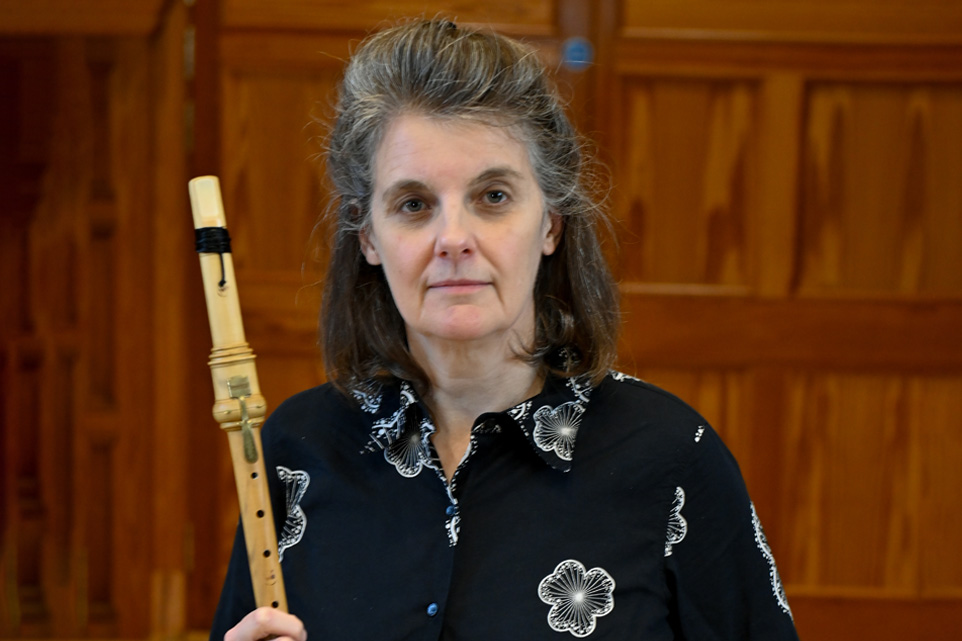
Senior Academic Tutor Dr Ingrid Pearson offers fascinating insights into the process of creating an early woodwind instrument, the chalumeau – an RCM-supported experience she describes as ‘life-changing’.
From boxwood to brass keys
Late last year at the workshop of Cambridge Woodwind Makers, I embarked on an extraordinary journey, making my own tenor chalumeau. Over seven days, I transformed three pre-seasoned pieces of boxwood, learning new skills and using a variety of machines and tools. This involved reaming wood, cutting it to size and drilling it, then turning the external profile of each piece and adding decorative features. I handmade two keys from sheets of brass, with pins to match, and applied leather pads with shellac using a blowtorch. Finally, the mouthpiece was hand-carved to accommodate the reed, tied on with beeswax-coated linen thread.
The chalumeau: a potted history
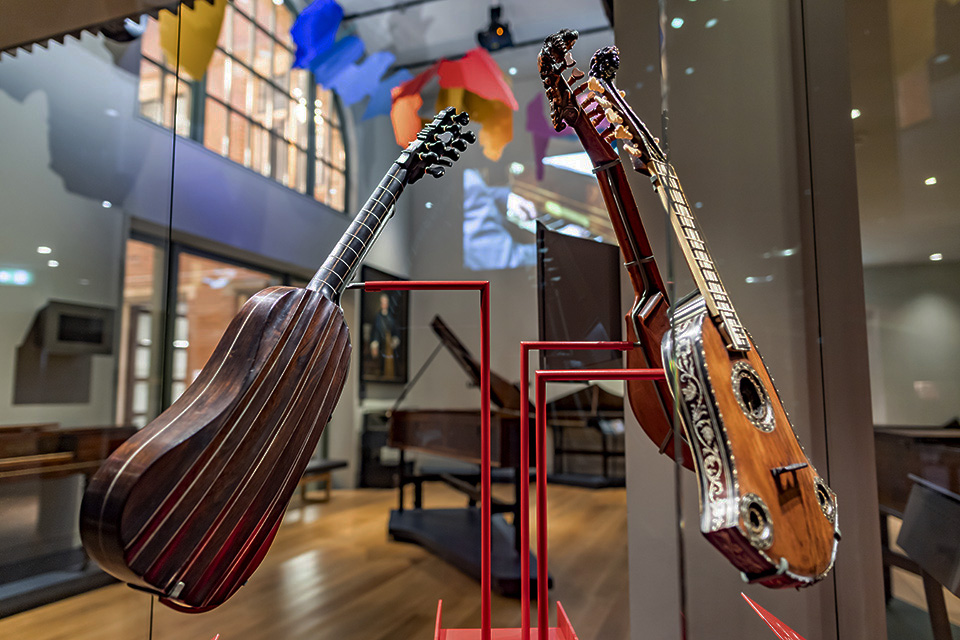
The two-keyed chalumeau was invented in the 1680s in the Nuremberg workshop of Johann Christoph Denner (1655–1707), founder of one the most important woodwind-making dynasties. By adding a single-reed mouthpiece to a recorder body, Denner invented a revolutionary new timbre and musical game-changer. Made in at least four sizes (soprano, alto, tenor and bass) the chalumeau became a highly desirable sonority in repertoire from c1690 to c1785.
This music embraces a range of composers far more representative than we usually hear today, including Johann Ludwig Bach, Dittersdorf, Fux, Handel, Camilla di Rossi, Telemann, Vivaldi and Zelenka, traversing sacred and secular genres including music for the stage (sung and danced) as well as chamber and orchestral works.
[image1]
Interest and individuality
By the mid-1780s, German writer and composer Christian Friedrich Schubart described the sound of the chalumeau as having ‘so much interest, individuality, and an endless pleasantness that the whole world of music would sustain a grievous loss if ever the instrument were to become obsolete’. As musical taste and patronage changed, venues and orchestras increased in size and by the last decade of the 18th century the chalumeau had effectively been supplanted by its sibling, the clarinet, by then a more generously mechanised instrument with a wider range.
From rarity to revival
Unlike the clarinet, there has been no continuous tradition of chalumeau performance, and instructive evidence is virtually non-existent. Although eight chalumeaux survive from the 18th century, none is playable for a significant length of time. The chalumeau’s revival began in the 1960s in tandem with the rise of historical performance. Since then, players have made recourse to instruments copied from originals.
Opportunities to make one’s own instrument are rare: this was the first ever chalumeau-making course offered internationally. It was led by clarinettist, maker and RCM alumnus Guy Cowley, under the watchful eye of Daniel Bangham, long-standing maker of celebrated copies of historical woodwinds. My instrument is a copy of the most celebrated 18th-century chalumeau, from the workshop of Johann David Denner, dating from c1730.
[quote quote="... so much interest, individuality, and an endless pleasantness that the whole world of music would sustain a grievous loss if ever the instrument were to become obsolete." author="Christian Friedrich Schubart, c1785"]
A life-changing experience
The chalumeau already enjoys strong Royal College of Music connections. Our Chair of Historical Performance and former Director, Professor Colin Lawson, completed his PhD on the instrument and its repertoire, and has recorded major solo and chamber works for chalumeaux. My own research seeks to reconcile the transformative power of a single reed with the physical affinity between the chalumeau and the recorder.
[image2]
I’m currently the only player embracing the challenges of performing with the historically more-prevalent reed-above embouchure. This project was a life-changing experience, and certainly one of the most rewarding I’ve undertaken. Thanks to the RCM for supporting me in this endeavour. Stay tuned for news of forthcoming performances, recordings and publications as my new creation finds its way within the world of music.
Read more about Historical Performance at the Royal College of Music: Historical Performance
A member of the RCM professoriate since 2005, Ingrid Pearson is known internationally as a scholar/performer of historical single-reed instruments. She works across the College’s undergraduate and postgraduate programmes.